Project DatabaseUtilities & Energy

W|EPC: Enterprise (EPD) PDH-2 Q420 Project Monitor & Satellite Image Review

November 2020

Total Pages: 18

Table Of Contents

W|EPC: Enterprise (EPD) PDH-2 Q420 Project Monitor & Satellite Image Review

  • Key Takeaways - Page 2

Cost & Schedule Updates

  • Cost Forecast - Page 4
  • Project Milestones - Page 5
  • Progress Analysis - Page 6
  • Project Comps - Page 7
  • On-Site Staffing - Page 8

Analysis & Satellite Image Review

  • Analysis - PDH 2 Recovery Potential - Page 10 
  • Recovery Plan Risk - Page 11
  • Progress Comparison - Page 12
  • Staffing Comparison- Page 13
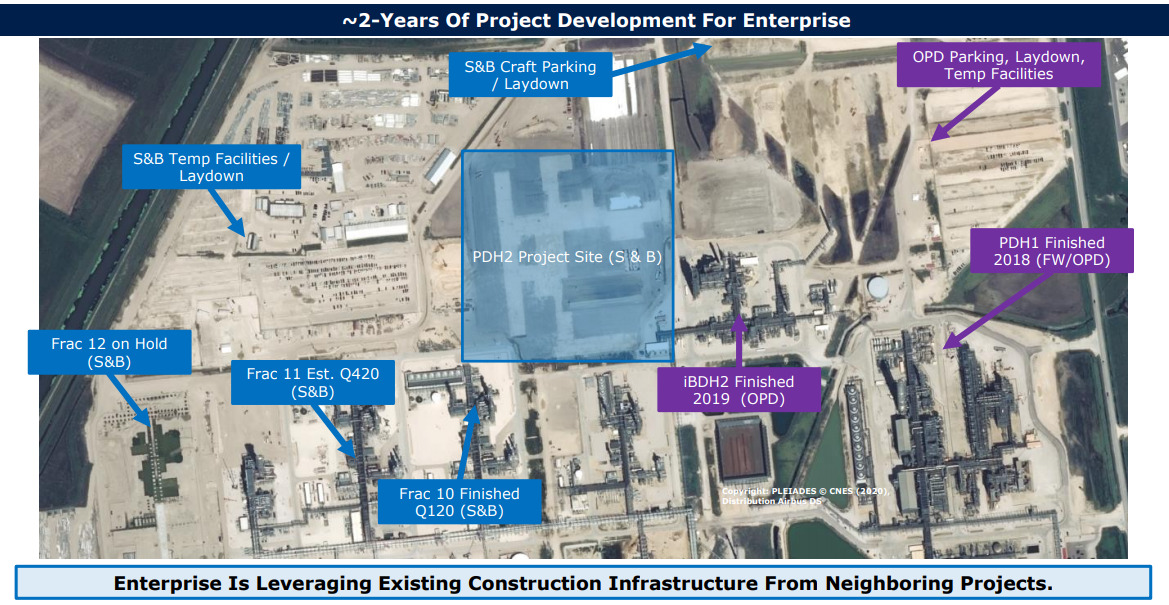
  • ~2 Years Of Project Development For EPD - 15
  • October 2020 Satellite Image - 16


 Key Takeaways:

1) EPD PDH 2 Project Delay Analysis    

Based on Q420 aerial project site images, W|EPC estimates Enterprise Products (EPD) PDH behind schedule by roughly... (pages 4 – 7)

In Q220, EPD announced a 3-month schedule slip (from Q123 to Q223), potentially limiting future change orders (i.e. cost escalation) related to COVID impact (based on typical EPC contract FM concepts).

To reduce the COVID delay to only 3 months, we believe EPD implemented a schedule recovery plan that accelerated/compressed back-end construction activities to meet a Q423 COD forecast. (pgs. 10 – 13)

2) Enterprise’s First ESG Guidance… :    

On October 28, 2020, EPD released their approach to ESG. In the report, EPD touts they are the largest Midstream producer of Hydrogen.

With the addition of PDH2, Enterprise would increase their Hydrogen production by [REDACTED] and could produce [REDACTED] by incorporating fuel cells in their Mont Belvieu, TX facility.

Companies like SK are working with fuel cell manufacturers to integrate high temperature Solid Oxide Fuel Cells (SOFC) into PDH units to use the hydrogen produced to reduce operating costs….this could help EPD’s ESG potential.

3) Schedule Recovery Risks & Benefits:   

A schedule recovery plan can be costly and is not guaranteed to succeed. PDH 2 schedule recovery risks/benefits include:
Risks – An EPC lump sum contractor (S&B) compresses the schedule & may cause inefficient construction & cost escalation.
Benefits – The COVID delay started before site prep and avoided a de-staffing of the project. Based on limited on-site progress, S&B likely hasn’t spent much of their field budget & may have available contingency to support acceleration costs/inefficiencies.

W|EPC’s Recovery Plan shows site labor and progress can support pulling activities back to Q223 with a  probability of success of.... (pgs. 10-13)
 

Recently viewed reports

Hydrogen Roadmap – Fuel Comparisons: Emissions, Feedstock, & CI Scores – Future Of Transportation (Part 3)

Hydrogen Roadmap – Fuel Comparisons: Emissions, Feedstock, & CI Scores – Future Of Transportation (Part 3)

February 2021
$850

W|EPC: Analyzing Energy Project Contract Terms – Risks, Strategies & Comps

W|EPC: Analyzing Energy Project Contract Terms – Risks, Strategies & CompsKey Takeaways:1) Analyzing EPC Risk Avoidance: Comps & Techniques For Investors, Owners, & Contractors    W|EPC analyzed ~$20B of publicly available EPC lump sum turn-key (LSTK) contracts, focusing on sensitive or contentious terms used to allocate risk, manage performance expectations, & establish a framework for third-party indemnification and liquidated damages, etc. (Pages 3, 5-7, & 9-17).  Specific points of emphasis:Investors: Leveraging a project’s future expansion plans to protect ROE and/ maximize options (ROFR) options. (Pages 5, 9-11)Owners: Finding & justifying onerous contract terms as market or on-the-run. Contractors: Avoiding those onerous contract terms.2) Analyzing Notable Risks:    Liability & Indemnity: Existing Facilities can be problematic for Contractors & expose stakeholders. (Pages 5, 9-11)• Performance Guarantees & Damages: Numerous performance guarantees were publicly disclosed (likely inadvertently) that illustrates risks & production, emissions, and/or power consumption liabilities. (Pages 6, 12-14)• Technical Risk Allocation: One project’s subsurface provisions are tighter and limit change orders provisions for differences in soils data. (Pages 7, 15-17)

December 2020
$2,900

W|EPC: Southern Company (SO) – Q420 Vogtle Project Monitor – Key Decisions That Could Haunt Cost Prudency

W|EPC: Southern Company (SO) – Vogtle Nuclear Expansion – Q420 Project Monitor – Key Questions That Could Haunt Cost Prudency
Key Takeaways: Vogtle Q420 Monitor – Key Decisions That Could Haunt Cost Prudency

• Who Will Be Getting Stuck With +$2.1B In Cost Overruns? Once Vogtle Unit 4 reaches “fuel load”, Georgia Power/Southern Company (GP/SO) can request a cost prudency determination to push their portion of cost overruns (~$2.1B) into recoverable utility rates. (Page 4)
Regulators will determine cost prudency based on project data, testimony, and a simple question: What should a reasonable manager have done at the time of the decision? (Page 5)
• We expect that process to be heavily scrutinized considering the scale of the overruns, and, in our opinion, some questionable GP/SO decisions. (Pages 4-5)

• Decisions That Could Haunt GP/SO’s Prudency. We believe there’s a case to be made that multiple GP/SO management decisions ran contrary to industry standards, potentially contributing to ($) billions in cost overruns, including
o A failure to either include or implement multiple EPC contract……(Page 7)
o For the first 4-years of the project, GP/SO used only…..(Page 23)
o In 2017, it appears GP/SO did not validate critical underlying EPC…..(Pages 9- 10)

October 2020
$1,900